We redesigned a website we built ourselves.
We built Extreme Metal Fabrication’s first website. Then we tore it down and started over — not because it broke, but because the web moved and their customers moved with it. Here is what changed, why, and what it says about how your own website should be treated.
Scroll to the bottom of Extreme Metal Fabrication’s old website and you would find four small words in the footer: Website by Cre8 My Site.
That’s right. The site we are about to walk you through, the one we retired, was ours.
Most agency case studies follow a predictable script. A business shows up with an ugly, broken website built by somebody else. The agency swoops in. Dramatic before and after. Everyone claps.
This isn’t that story. This is an agency looking at its own work a few years later and saying: this doesn’t represent this business the way it should any more. Let’s fix it.
 AfterBefore
Because here is the truth most web designers won’t tell you: a website is not a one-time purchase. It is closer to a storefront. The day it opens, it looks sharp. A few years later the paint has faded, the signage is dated, and the neighborhood has changed around it. Nothing is technically broken. It just doesn’t look like the business inside any more.
That is what happened here. How we handled it is what partnering with Cre8 My Site is supposed to look like.
A website isn’t a project you finish. It’s a storefront you maintain. The paint fades whether you’re watching or not.
Meet the client: Extreme Metal Fabrication
Extreme Metal Fabrication, known around the bayou as EMF, is a family-run custom aluminum boat shop at 4345 Highway 70 South in Pierre Part, Louisiana. Robert and Lynn build aluminum duck boats, skiffs, modified V boats, V-bottom boats, and pontoons and barges, all made to order in their own shop.
Their customers aren’t browsing a showroom floor. They are hunters, fishermen and working people who spend real time on real Louisiana water, and who want a boat built for the way they actually use it. Hull type, dimensions, motor, catwalks, deck layout, dry storage. Every build is a conversation.
That is EMF’s biggest advantage over any retail boat dealer. You don’t talk to a salesman, you talk to the people welding your hull, and you can stop by the shop and watch your boat come together. Their customers notice. One of their reviews puts it plainly:
“The quality of their work is second to none. If you’re expecting to find higher quality workmanship on custom aluminum boats, you’re going to be sadly disappointed if you look somewhere else!” — Taylor C., EMF customer
A business like that deserves a website that feels like walking into their shop. The old one didn’t any more.
The old site wasn’t bad. It was a product of its time.
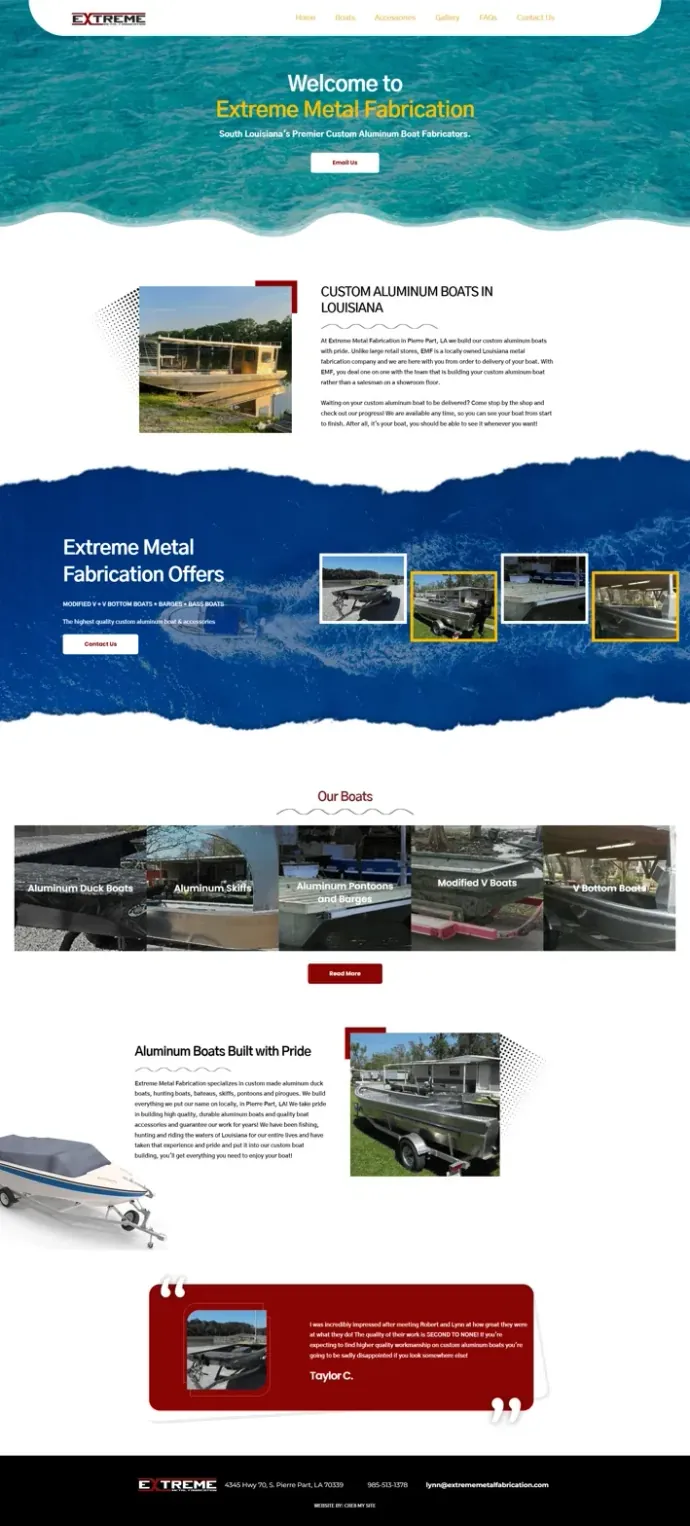
Let’s be fair to our former selves. When we built EMF’s original site it checked the boxes that mattered then: a bold hero, the company name front and center, the boat lineup, a testimonial, contact information. It was colorful, energetic, and a massive step up from having no real web presence at all.
But look at it with fresh eyes in 2026 and a handful of things jump out:
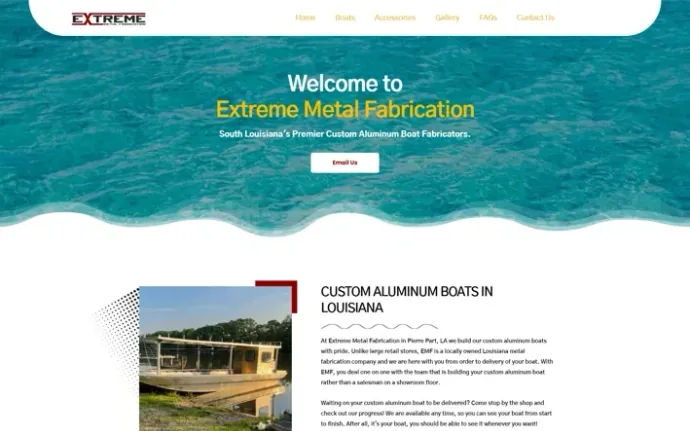
- The hero was turquoise tropical ocean water. It’s a nice picture. It is not what a duck hunter in Assumption Parish pictures when he thinks about where his boat is going. Stock water sold a vibe, not the product.
- The headline said “Welcome to Extreme Metal Fabrication.” Visitors already know where they landed. A headline’s job is to tell them why they should stay.
- The main call to action was “Email Us.” For a shop where every sale starts with a conversation, keeping the phone number in the footer made the most natural next step harder than it needed to be.
- There was a stock photo of a fiberglass runabout. For a company that builds custom aluminum boats. Nobody caught it for a while, which is exactly how dated details creep in.
- The design language had aged. Wavy dividers, halftone dot patterns, torn-paper section edges, offset color blocks behind photos. All of it was everywhere around 2020 to 2022. Today it reads as template, not craftsmanship.
- The boat categories were text over darkened photos. Stylish at the time, but harder to read and harder to scan on a phone, where most people were visiting from.
None of those things were broken. That is the point. Websites rarely fail loudly. They fade quietly, one outdated detail at a time, until the site is telling a slightly different story than the business behind it.
What we changed, section by section
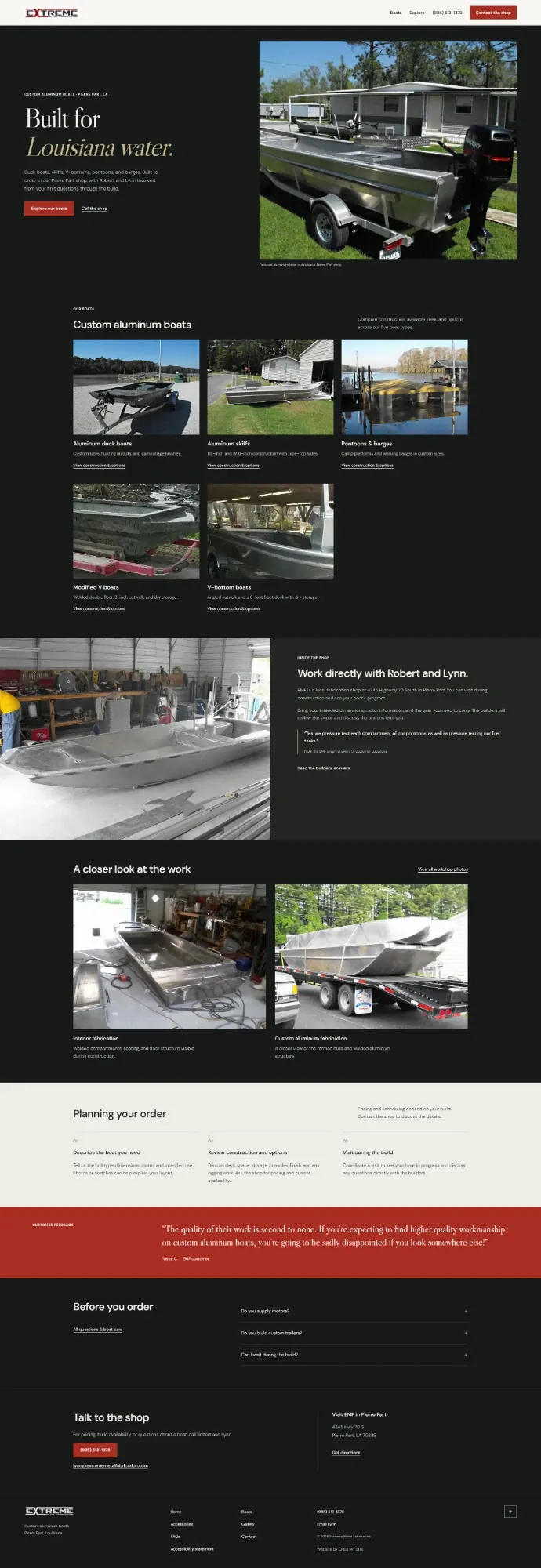
The goal was simple to say and harder to execute: make the website feel like the shop. Real boats, real people, real Louisiana water, and a clear path from “that looks nice” to “I’m calling Robert.”
A headline that actually says something
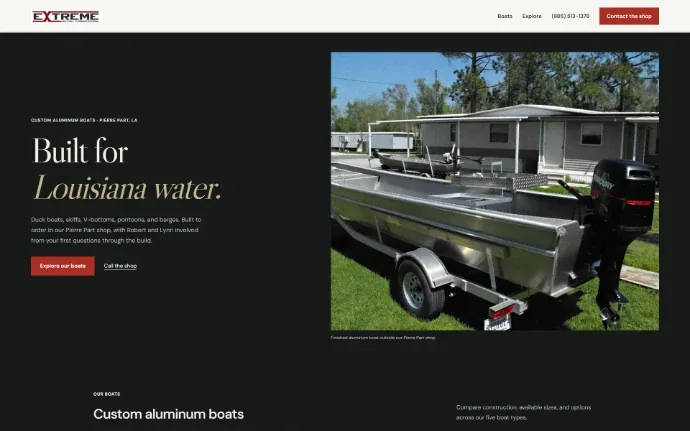
The new hero opens with “Built for Louisiana water.” Four words that do more work than the entire old headline. It tells you where they are, who they build for, and what makes their boats different from something shipped in from out of state.
Right above it sits a small line: Custom aluminum boats · Pierre Part, LA. That is not decoration. It puts the core service and the location in front of both visitors and search engines within the first second of the page.
And the hero image is a real finished EMF boat on its trailer outside the Pierre Part shop, with a caption that says exactly that. No stock photography. No tropical water. Just the product.
A phone number you can actually find
The shop’s number now sits in the top navigation on every page, next to a “Contact the shop” button. The hero offers two paths: “Explore our boats” for people still browsing, and “Call the shop” for people who are ready. The contact section repeats the phone, email, address and a link to directions.
For a business where nearly every sale begins with a conversation, that one change may matter more than everything else on this list combined.
A boat lineup built for comparison
The five boat types are now clean cards with real photography and, more importantly, a real construction detail on each one. Aluminum skiffs with 1/8-inch and 3/16-inch construction and pipe-top sides. Modified V boats with a welded double floor, a 3-inch catwalk and dry storage. V-bottom boats with an angled catwalk and a 6-foot front deck.
Those specifics do two jobs. For buyers, they answer questions before the phone call happens. For search engines, they are exactly the kind of detailed, specific content that helps a page turn up for a long-tail search like “aluminum skiff 3/16 construction Louisiana.” Each card links to its own construction and options page, which strengthens the site’s internal linking too.
Putting Robert and Lynn front and center
The old site mentioned that you deal directly with the builders. The new site builds a whole section around it: Work directly with Robert and Lynn. It explains that you can visit the shop during construction, bring your dimensions and gear list, and talk through the options with the people doing the work.
It also pulls a line straight from the shop’s own answers to customer questions: “Yes, we pressure test each compartment of our pontoons, as well as pressure testing our fuel tanks.” That is the kind of detail that builds trust in a way no marketing copy can. It is specific, it is technical, and it sounds like a craftsman, because it came from one.
A clear three-step ordering process
Custom work makes people nervous when they don’t know how it works. So the new site spells it out in a Planning your order section. Describe the boat you need. Review construction and options. Visit during the build.
Three steps, plain language, and a note that pricing and scheduling depend on the build. It removes the uncertainty that stops a lot of people from ever picking up the phone.
Real workshop photos instead of decoration
A section called A closer look at the work shows interior fabrication, welded compartments, seating, floor structure and formed hulls mid-build. Each photo has a caption describing what you are looking at.
Those captions aren’t only helpful. They give screen reader users the same information everyone else gets from the picture, and they give search engines more context about the page. Good design and good SEO keep turning out to be the same thing.
Answering questions before they are asked
The homepage now carries a short Before you order section with the questions EMF hears constantly. Do you supply motors? Do you build custom trailers? Can I visit during the build? Each one expands to an answer, with a link to the full list.
Questions formatted this way are what Google and AI search tools tend to pull from when someone asks a direct question. It is one of the simplest ways a small business can turn up in more places without writing a single extra page.
A calmer, more confident look
Visually, the new site trades busy effects for restraint: a deep charcoal and warm off-white palette, EMF’s red used sparingly for emphasis and calls to action, and an elegant serif headline against a clean sans-serif. It reads less like a template and more like a craftsman’s portfolio, which is what EMF is.
The footer also carries an accessibility statement now, alongside the standard navigation.
Before and after at a glance
| Element | Before | After |
|---|---|---|
| Hero headline | “Welcome to Extreme Metal Fabrication” | “Built for Louisiana water.” |
| Hero image | Stock turquoise ocean water | A real finished EMF boat outside the Pierre Part shop |
| Primary call to action | Email Us | Explore our boats, and Call the shop |
| Phone number | Footer only | Top navigation, hero and contact section |
| Boat lineup | Text over darkened photo tiles | Five cards, each with a construction spec and its own detail page |
| The people | Mentioned in body copy | A full section: work directly with Robert and Lynn |
| Ordering process | Not explained | Three steps, from describing the boat to visiting the build |
| Buyer questions | A separate FAQ page | The top questions answered on the homepage |
| Design language | Wave dividers, halftone dots, torn-paper edges | Clean editorial layout, real photography, restrained color |
Why we didn’t just leave it alone
Here is a fair question: if the old site worked, why touch it?
Because “works” is a low bar, and the bar keeps moving. A few things have shifted since EMF’s first site went live, and they shift for every business:
- Design expectations change. What looked modern three years ago reads as dated to the exact customers you want to impress. People judge a business’s credibility by its website in a fraction of a second, against everything else they have seen that week.
- Search engines reward specificity. Generic copy used to be enough. Detailed, genuinely useful content about your actual services, your actual process and your actual location does better now.
- AI search is changing how people find businesses. Tools like ChatGPT and Google’s AI Overviews pull answers from clear, structured, specific content. A page full of real construction details and answered questions is far more useful to them than a page of welcome messages.
- Mobile behavior keeps evolving. Most visitors arrive on a phone, often one-thumbed, usually with a quick question. The site has to answer it fast and make calling effortless.
- Your business changes too. New boat types, new photos, new answers to new questions. A website frozen in time slowly stops describing the business you actually run.
The best time to refresh a website is before anyone notices it needs it. By the time your customers notice, they have already formed an opinion.
This is what a partnership looks like
A lot of web designers work to a simple model. You pay, they build, they hand you the keys, and you never hear from them again. Two or three years later your site is dated and you are shopping for a new designer to start the cycle over.
That is not how we work, and EMF is the proof.
When you partner with Cre8 My Site, your website isn’t a finished product sitting on a shelf. It is an active part of your business that we keep watching, updating and improving as your business grows and the web changes around it. We keep up with it so you don’t have to.
That means we tell you when something on your site has aged. We suggest changes before your competitors make them. And when a full refresh makes more sense than another round of patches, we say so plainly, even when it means redesigning our own work. (We did the same thing to our own website.)
We would rather rebuild something we made than let a client’s website quietly fall behind. That is the standard. EMF just happens to be the clearest example of it.
Is your website quietly falling behind? Five signs
You don’t need a designer’s eye to spot a site that is aging. Pull yours up on your phone and ask:
- Does the headline tell a stranger what you do and where, or does it just say welcome?
- Are the photos your actual work, your actual team and your actual location, or stock images?
- Can someone call you in one tap from the top of the page?
- Does the site answer the three questions you hear most often, right on the homepage?
- Does the design look like it belongs in 2026, or like it is still wearing 2021’s wavy dividers?
If two or more of those made you wince, your website is telling a slightly different story than your business. The good news is that it is fixable, and it doesn’t have to mean starting over from zero.
Let’s keep your website fresh
Whether you need a first website, a refresh of an aging one, or a partner who will keep it current for the long haul, that is what we are here for. Every Cre8 My Site plan is month to month, with no setup fees and no long-term contracts. We keep your business by keeping your website worth being proud of. You can see the sites we have built, EMF included.
And if you are in the market for a custom aluminum boat built for Louisiana water, call Robert and Lynn at Extreme Metal Fabrication on (985) 513-1378. Tell them Cre8 sent you.
Cre8 My Site is a faith-driven, AI-powered web design and local SEO agency in Ponchatoula, Louisiana, building and maintaining websites for small businesses across the Northshore and South Louisiana.
Is yours aging? We’ll tell you straight.
Start with a free site audit. We look at your website, your Google Business Profile and your top competitors, then tell you honestly what is working, what has aged, and what we would change first. Keep the list whether you work with us or not.