Your website does not need another patch. It needs rebuilding.
Four rebuilds we finished recently — a boat shop, a travel agency, a patio builder and a pressure washing company. In every one, the thing that actually needed changing was not how the site looked. It was how it was built.
Every website eventually reaches the same fork in the road.
Something is not working. The design feels tired. You are not ranking for services you know you are good at. A competitor’s site looks better than yours and it has started to bother you. So you call someone and ask what it would cost to fix.
The answer you usually get is a patch. Freshen up the homepage. Swap the photos. Add a page. Update the colors. It is cheaper, it is faster, and it feels like the responsible choice.
Sometimes it is. Often it is not, and the reason is simple: a patch can change how your website looks. It cannot change how your website is built.

Those are two different problems, and most small businesses that stay stuck online are stuck because they keep paying to solve the first one while the second quietly costs them customers.
Patches fix content problems — stale photos, wrong hours, a broken form. Rebuilds fix structural problems — no individual service pages, no service-area pages, slow load times, a layout that does not convert on a phone, a design that no longer reads as current. If your problem is structural, patching costs money without changing the outcome.
Why three years, roughly
There is nothing magic about thirty-six months, and we would rather say so than pretend otherwise. You will see “every three to four years” quoted all over the industry with no study behind it. We have said as much before.
What is real is that three years is about how long it takes for enough separate things to shift that a site is no longer built for the environment it lives in. Five of them move underneath you at all times.
Design expectations move fast
People judge a page quickly. In a 2006 lab study by Gitte Lindgaard and colleagues, viewers formed consistent visual-appeal judgments of web pages shown for just 50 milliseconds — the finding was about aesthetic impressions under controlled conditions, not about whether anyone eventually calls you, and it is worth keeping it in that lane.
The practical part needs no study. Visitors are not comparing your site to what was modern when it launched. They are comparing it to whatever they looked at an hour ago. Layout, type, spacing and photography conventions shift noticeably every couple of years, which is why a site built in 2021 does not just look older. It looks like nobody has been paying attention.
Devices and browsers keep changing
Mobile is now the majority of web traffic — Statcounter put smartphones at roughly 52% of global page views through 2026, and closer to 60% once tablets are counted. The number that actually binds you, though, is not traffic share: Google finished moving to mobile-first indexing, so the mobile version of your site is the version it crawls and ranks.
A site designed desktop-first and squeezed down behaves like exactly that, and visitors feel it even when they cannot name it.
Google’s requirements keep tightening
Speed, mobile usability and content quality all carry more weight than they used to. The most-quoted number here — that 53% of mobile site visits are abandoned when a page takes over three seconds — comes from Google and DoubleClick’s “The Need for Mobile Speed,” published in September 2016. It is a decade old and measured on 3G-era connections, so treat it as a direction rather than a current benchmark. The direction has not reversed.
Local visibility compounds the effect. In the largest published test of where people click on a local results page — BrightLocal’s 2018 study with 5,500 testers — the Map Pack took 29% to 32% of clicks, more than any single organic listing. Getting into it depends heavily on site structure, not just on your Google Business Profile.
AI search arrived and moved the target
This one is new enough that most websites were never built for it, and it is also the area where the statistics get stretched hardest, so here is the careful version.
Whitespark ran 540 searches across Houston, Phoenix and Denver in six industries and found AI Overviews on 68% of them, against 39% for the traditional local pack. Read the methodology before you repeat that: the queries were deliberately split across local, informational and hybrid intent, and Whitespark says plainly that “the nature of our queries certainly impacted the degree to which we saw local packs appear.” Informational questions pulled AI Overviews almost every time. Straightforward transactional searches still leaned on the local pack. So the honest reading is not that AI has replaced the map — it is that AI now sits in front of a large share of the questions people ask on the way to choosing a business.
Two other figures are better grounded. SparkToro, using Similarweb clickstream data for January through April 2026, put the U.S. zero-click rate at 68.01%. And BrightLocal’s 2026 Local Consumer Review Survey of 1,002 U.S. adults found 45% had used AI tools to find a local business, up from 6% the year before.
What all of this rewards is the same thing: plain, visible, specific content. AI systems extract answers, details and real numbers. A brochure site gives them nothing to work with. A site with genuine service detail gives them plenty. That is a structural difference, not a cosmetic one, and it is a longer subject on its own.
Compliance expectations shifted too
Federal website accessibility lawsuits reached 3,117 filings in 2025, up 27% from 2,452 the year before, according to Seyfarth Shaw’s tracking. Accessibility is not a widget you add. It is heading structure, alt text, keyboard operation, color contrast and semantic markup — built in or not.
Nothing about your website breaks on its own. The ground underneath it moves, and eventually the site is standing in the wrong place.
A patch changes what your website looks like. A rebuild changes what it can do. Only one of those shows up in your call volume.
Patch or rebuild? The honest line
Not everything needs a rebuild, and an agency telling you otherwise is selling rather than advising. Here is the actual dividing line.
| The problem | Verdict | Why |
|---|---|---|
| Outdated photos or stale copy | Patch | Swap the images, rewrite the paragraph. No structural change needed. |
| Wrong hours or a changed phone number | Patch | A content update, and one you should never have to wait on. |
| A broken contact form | Patch | Fix it today, then monitor it so the next failure does not go unnoticed for six weeks. |
| One service buried on a shared services page | Rebuild | Separate service pages mean new architecture, navigation and internal linking. |
| No pages for the towns you actually serve | Rebuild | A service-area system means dozens of new pages, a URL structure and menu design. |
| Slow load times across the whole site | Rebuild | Usually the platform, theme or image pipeline — not something a plugin fixes. |
| Does not convert on a phone | Rebuild | Conversion paths are structural. You cannot bolt a mobile-first layout onto a desktop-first site. |
| Design reads as five years old | Rebuild | Patching one section against a dated template makes the rest look worse, not better. |
The pattern is consistent. If the fix lives in the content, patch it. If the fix requires changing how pages relate to each other, how the site loads, or how a visitor moves toward contacting you, you are looking at a rebuild — and patching instead just means paying for something that will not move the number you care about.
Four recent rebuilds, and what actually changed
Here is where it gets concrete. Four businesses, four sets of structural changes, none of them achievable with a patch.
Extreme Metal Fabrication — Pierre Part, Louisiana
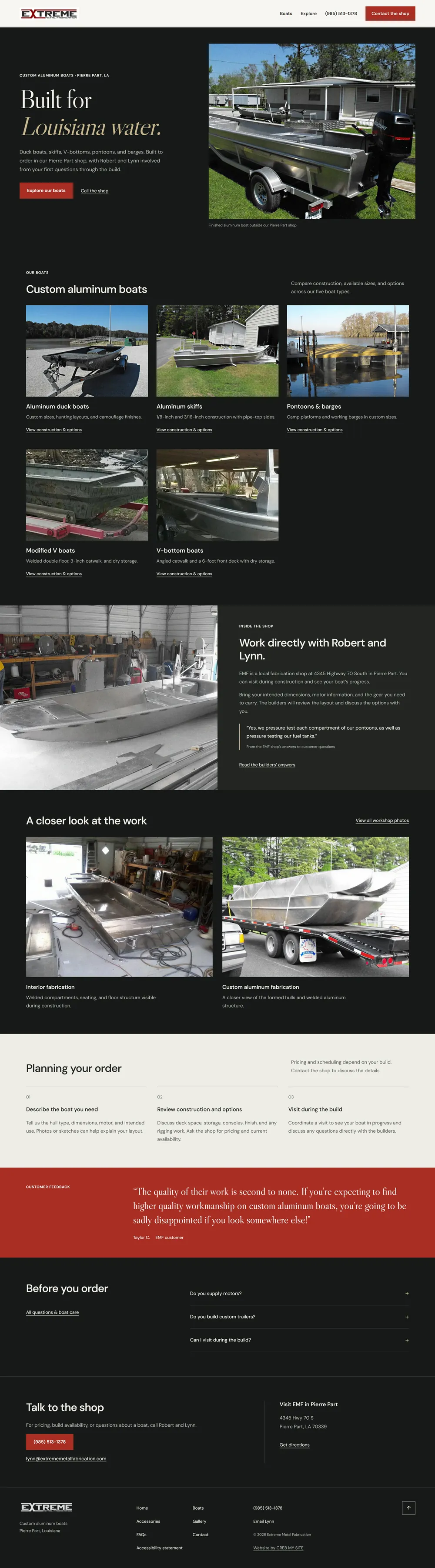
EMF builds custom aluminum boats — duck boats, skiffs, modified V boats, V-bottoms, pontoons and barges. Robert and Lynn build every one to order in their own shop in Pierre Part.
The old site listed the boat types as text over darkened photo tiles on a single page. The new one gives each of the five types its own page, with real construction detail in the preview copy: “1/8-inch and 3/16-inch construction with pipe-top sides” on the skiffs, “welded double floor, 3-inch catwalk, and dry storage” on the modified Vs, “angled catwalk and a 6-foot front deck” on the V-bottoms.
That does three things a patch could not. Each boat type gets a page that can rank for its own searches. Buyer questions get answered before the phone call. And it produces exactly the kind of specific, extractable content AI systems favor — including a direct answer from the shop: “Yes, we pressure test each compartment of our pontoons, as well as pressure testing our fuel tanks.”
The headline changed from a generic welcome to “Built for Louisiana water,” with the line “Custom aluminum boats · Pierre Part, LA” putting the service and the place in the first second of the page. The phone number moved out of the footer into the navigation and the hero. The build added a three-step ordering process, an FAQ, descriptive image captions, an accessibility statement and a sitemap. We wrote up the whole EMF redesign separately, with the before and after side by side.
Making Waves Adventures — travel agency
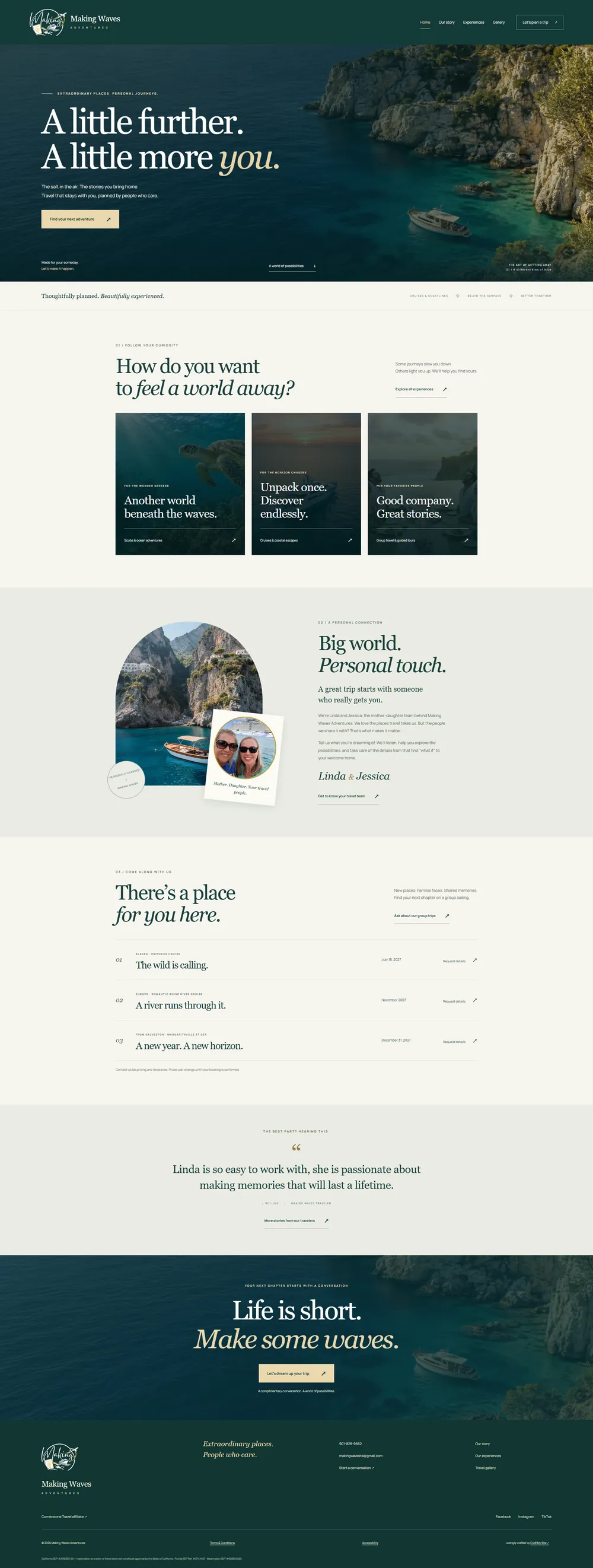
Linda and Jessica are a mother-and-daughter travel team planning cruises, scuba trips and group travel. The business runs on relationships, which meant the site had to do something most service sites do not: carry a personal connection through a screen.
Structurally, the rebuild centered on booking paths. Upcoming group sailings — an Alaska Princess cruise in July 2027, a Rhine river cruise that November, a New Year’s Eve Margaritaville at Sea departure from Galveston — each have a request link with the subject line prefilled, so an interested traveler does not have to compose an email from scratch. A Calendly integration books a complimentary planning conversation directly. A client planner portal lives on its own subdomain.
The industry also carries compliance requirements most businesses do not have. Seller of travel registrations for California, Florida and Washington now sit in the footer alongside terms, privacy and accessibility pages. That is the sort of thing added properly during a rebuild and awkwardly during a patch.
Central Patios — Livingston, Louisiana
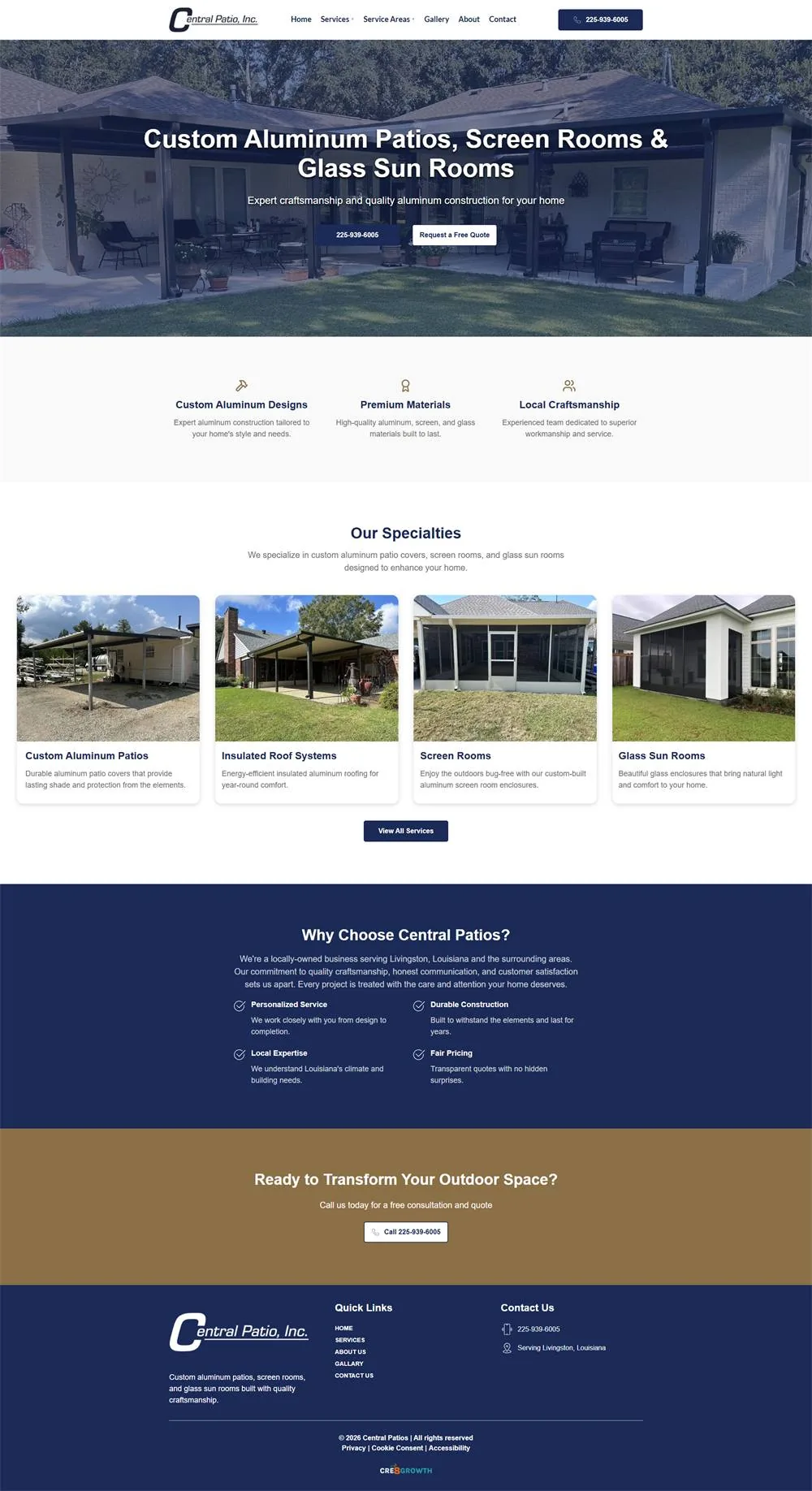
Central Patios builds custom aluminum patio covers, screen rooms, glass sun rooms and insulated roof systems across a wide stretch of southeast Louisiana.
The defining change was geographic. The new site has dedicated service-area pages for twenty communities — Livingston, Walker, Watson, Denham Springs, Albany, Springfield, Holden, Hammond, Ponchatoula, Tickfaw, Natalbany, Robert, Independence, Loranger, Husser, Amite City, Covington, Baton Rouge, Port Allen and Central — each on a consistent URL built around custom patio covers in that city.
You cannot patch your way to that. Twenty pages on a deliberate URL pattern, surfaced through navigation that keeps them findable without burying the rest of the site, is architecture. And it matters because somebody in Walker searching for a patio cover and somebody in Port Allen searching for the same thing are two different searches. One page does not win both.
The services menu was also restructured into products and specialty services, with a tappable phone number in the navigation and a persistent quote path on mobile.
X-Stream Clean — southeast Louisiana
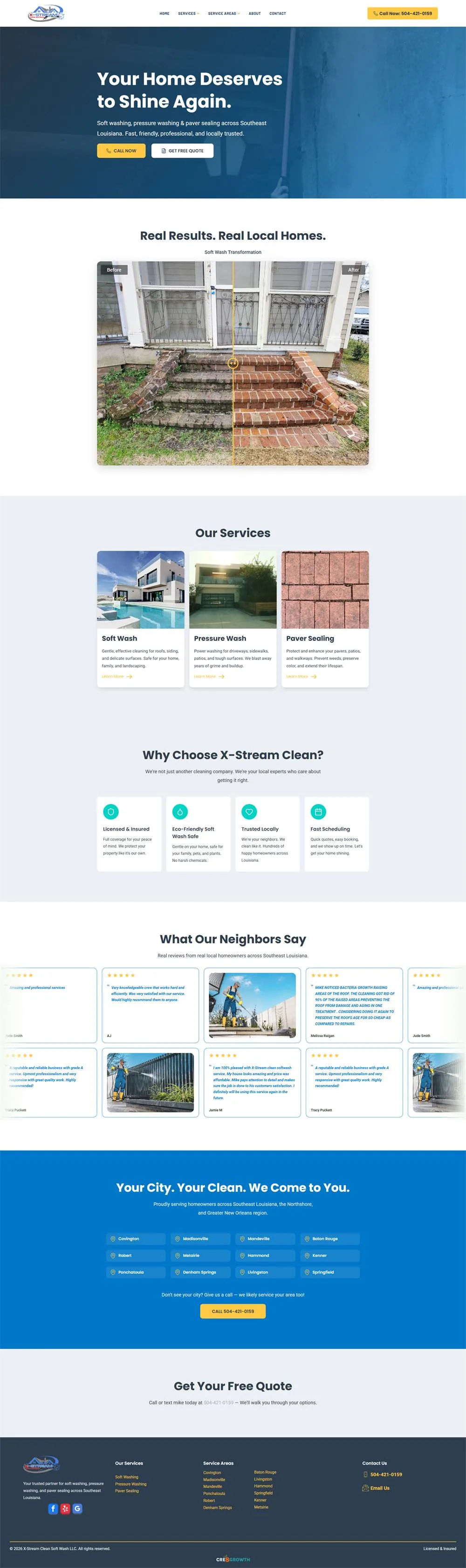
Mike’s pressure washing company offers soft washing, pressure washing and paver sealing across the Northshore, Baton Rouge and greater New Orleans.
This rebuild took the service-area idea further by crossing services with cities. Each of the twelve cities has its own hub page, and each city also has separate pages for soft washing, pressure washing and paver sealing individually. Someone in Madisonville searching specifically for paver sealing lands on a page about paver sealing in Madisonville — not a general services page with a city name sprinkled in.
The homepage leads with “Your Home Deserves to Shine Again” and a before-and-after of a real local job, because in pressure washing the proof is visual and it belongs above the fold. Trust markers — licensed and insured, soft wash safe for pets and plants, fast scheduling — are structural elements rather than paragraphs nobody reads. The footer links out to the business’s Google Maps listing, Yelp page and Facebook page, which supports the citation consistency local rankings depend on. And both call and text are available everywhere, because a lot of people would rather text a photo of their driveway than make a phone call.
The pattern across all four
Different industries, different goals, the same underlying changes. Every one of these rebuilds did the following.
- Replaced a generic headline with one that states what the business does and where
- Moved the phone number and primary action into the navigation, the hero and the footer, tappable everywhere
- Broke a single services page into individual pages per service, each with real detail
- Built a service-area page system where the business serves multiple towns
- Replaced stock imagery with real photos of real work, with descriptive alt text
- Added genuine answers — FAQs, process steps, specifications — that buyers and AI systems can both use
- Built accessibility in from the foundation rather than bolting on a widget
- Added proper meta and social structure so links look right when shared
Look at that list again. Every item changes what the site is capable of, not how it appears. That is the whole distinction — and it is why businesses that keep patching keep arriving back at the same fork two years later.
When a patch genuinely is the right call
We would be overselling if we said every site needs a rebuild on a three-year timer. Plenty do not.
If your site was built in the last couple of years on a solid foundation — fast, mobile-first, properly structured, with individual service pages and accessibility handled — then patching is exactly right. Update the photos, refresh the copy, add the new service page, keep going. That is maintenance working as intended.
If your website is genuinely simple and that suits your business — one page with a phone number, for a business that runs entirely on referrals — a rebuild may be solving a problem you do not have.
And if the only thing wrong is that you are bored of looking at it, that is worth being honest with yourself about. Boredom with your own branding is normal, and it is not the same as a website underperforming.
The case for a rebuild is specific: your site cannot do things you need it to do, and no amount of content editing will change that.
Signs you are past patching
Pull your site up on your phone and run through these.
- You offer several services and they all live on one page
- You serve several towns and have no pages for them
- The site takes more than three seconds to load on cellular data
- Your phone number is not tappable from the top of the screen
- You cannot add a page or edit content without calling someone
- The design was built before 2022
- You have no accessibility statement and no idea whether the site is usable with a keyboard
- Images are stock photos rather than your actual work
- The site answers none of the questions you get asked every week
- You rank well for your business name and nothing else
Three or more and you are patching a structural problem.
If the fix lives in the content, patch it. If the fix requires changing how the pages relate to each other, you are looking at a rebuild.
Common questions
How often should a website be redesigned?
Every three to four years is the usual answer, and you should know there is no study behind it. It is a rule of thumb. What is real is that design conventions, device standards, Google’s requirements and search behavior all shift on roughly that timescale, and eventually a site is no longer built for its environment. Content should be updated continuously in between regardless.
Is a redesign the same as a rebuild?
Not quite, and the difference matters. A redesign changes how a site looks. A rebuild changes how it is structured — page architecture, URL structure, load performance, conversion paths, accessibility. Most sites that need help need the second one, which is why a purely visual redesign often disappoints.
Will a rebuild hurt my search rankings?
Not if it is handled correctly. Existing URLs need to be mapped and redirected, titles and meta descriptions preserved or improved, and content carried over rather than discarded. Done properly, rankings usually improve because the new site is faster and better structured. Done carelessly, a rebuild can absolutely cost you rankings — which is a good reason to ask any provider how they handle redirects before you hire them.
What does a website rebuild cost?
Agency pricing guides generally put a full rebuild of a neglected small business site between $3,000 and $15,000 as a one-time project, though those guides are written by the agencies quoting the prices, so read them as a market signal rather than research. We handle rebuilds inside monthly plans instead, starting at $179 a month with no setup fee and no long-term contract, which spreads the cost and includes the ongoing maintenance that keeps the site from aging back into the same problem. Our plans and prices are public.
Can I just add pages to my existing site?
Sometimes, yes. If your current platform and structure can support individual service pages and a service-area system cleanly, adding pages is the right move. If the site is slow, desktop-first, or built on a template that fights you every time you add something, you will spend more fighting the old structure than replacing it.
How long does a rebuild take?
Most small business rebuilds run a few weeks from kickoff to launch, with the bulk of the time spent on content, photography and structure rather than design. The ones that take longest are waiting on photos and written content from the owner, so having those ready speeds things up considerably.
Visual-appeal timing from Lindgaard et al., Behaviour & Information Technology, 2006. Device share from Statcounter, 2026. Mobile-first indexing and the three-second abandonment figure from Google, the latter published September 2016 and measured on 3G-era connections. Map Pack click share from BrightLocal’s 2018 study of 5,500 testers. AI Overview prevalence from Whitespark’s 540-query study across three cities, which mixed local, informational and hybrid intent. Zero-click rate from SparkToro with Similarweb data, January–April 2026. AI adoption from BrightLocal’s 2026 survey of 1,002 U.S. adults. Lawsuit counts from Seyfarth Shaw. Client sites are Cre8 My Site projects and the details describe publicly visible structure at the time of writing.
Patch or rebuild? We will tell you straight.
We review your website, your Google Business Profile and your top three competitors, then say plainly which one you need. If a patch gets you there we will say so — it is the smaller job, and we would rather be straight with you than oversell. If the problem is structural, we will show you exactly which parts and why. You keep the findings either way.